
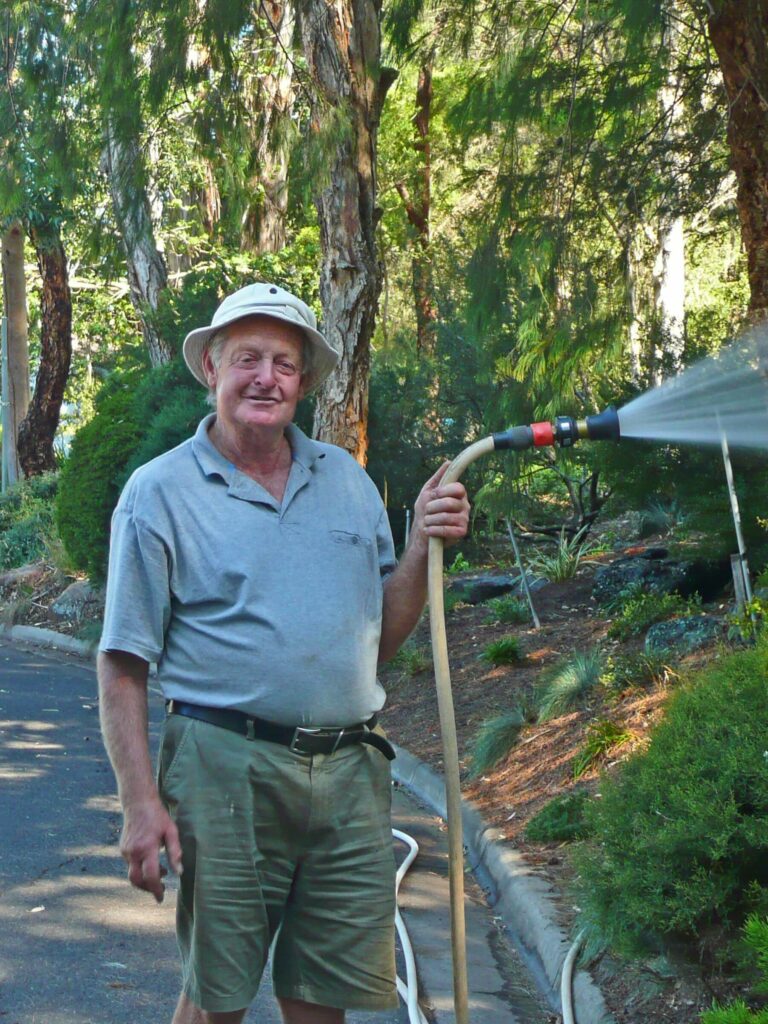
Earlier this year, members of the APS Keilor Plains Group visited the Kevin Hoffman Walk, as part of their day trip to Anglesea. After their visit, member Ros Nataprawira kindly wrote a detailed reflection for their newsletter, capturing the history, plant life, and spirit of the Walk beautifully. Ros has generously given us permission to share her article with our community. The photo of Kevin watering the garden, taken back in 2011, was also taken by Ros and adds a lovely touch of nostalgia to the story.
Enjoy Ros’s Article Below:
“There wasn’t a cloud in the sky on Saturday, July 12th, 2025 as a small group of APSKP members (plus two mothers) assembled at Wingara Drive in Lara for the start of our day trip to Anglesea. The reason for breaking our journey mid-way was to visit the Kevin Hoffman Walk, a remarkable Australian native garden occupying about 900 linear metres of embankment on the eastern side of Hovells Creek, which at this point, becomes a series of connected water holes. Our group last visited the garden in 2011 when Kevin, himself was on site. This time, Neil had arranged for Greg Wilson, the President of Friends of Kevin Hoffman Walk to be our guide. The Friends group was formed in 2013 to assist Kevin, who sadly, died last year.
Greg shared some of the history of the garden before we set off on our tour. The story began in 1970 when Kevin and Beverley Hoffman, then in their twenties, moved into a new house in Wingara Drive. The young eucalypts planted by the estate developer opposite their house were struggling to survive so Kevin and Beverley began bucketing water from the creek to them. When that water proved brackish, Kevin used his own water supply to water the trees in the street. He proceeded to clear rubbish and African boxthorn from the creek bank and began extending his front garden to include the nature strip and creek bank. Facing an astronomical water bill during a drought, Kevin, as Greg recounted, “went native”, buying drought-tolerant plants, including many colourful West Australian species, from Kuranga and a nursery at Mount Gambier.
We started our tour at the southern end of Hoffman’s Walk. At this end of the garden the bottle tree Neil photographed when our group visited fourteen years ago is a focal point. Unfortunately, it has split and will eventually need to be replaced. As we proceeded there was much botanical interest to photograph. Towering shrubs of Banksia praemorsa and Hakea bucculenta looked spectacular in flower against the clear blue sky. Background shrubs, especially those with textured foliage, such as Chorilaena quercifolia, fill the layers between flowering plants. Drifts of strappy-leaved plants like Dianella caerulea suppress weeds and provide unity and rhythm throughout the garden.
A beautiful shrub that we spent some time admiring was Grevillea halmaturina subsp. laevis. Winter-flowering Grevilleas provide both food and shelter for the smaller birds. Greg mentioned that in spring, bird-song adds another dimension to the garden’s appeal. To date, 54 species of birds have been recorded.
Having a guided tour made a big difference to our appreciation of the garden. We learnt that Kevin went out of his way to find hard landscaping elements to enhance the garden, including installing some of the heavy timber fence posts from the historic Newmarket Saleyards when they came up for sale. The impressive, rammed earth landscape features at the main entrance to the garden were made by Kevin. His son-in-law, a metal worker, created the sculpture set into the entrance wall
The days when Kevin Hoffman hand-watered the garden are over. Today the garden is watered by a smart irrigation system that allows for zone-specific watering managed through a smartphone app. Golden Everlasting Paper Daisies (Xerochrysum bracteatum) have been planted at strategic points as “indicator plants”. If they begin to wilt, Greg knows to adjust the irrigation in that zone. Funds raised by the Friends Group through sponsorships and sales of their calendar and greeting cards pay for a gardener to be employed for five hours a week. The Greater Geelong Shire Council works in partnership with the Friends group to supply mulch, manage the trees and maintain the infrastructure. We could have remained longer but our Anglesea lunch stop at Coogoorah Park was an hour away!”
Photo Supplied by & Article Written by: Ros Nataprawira