
History
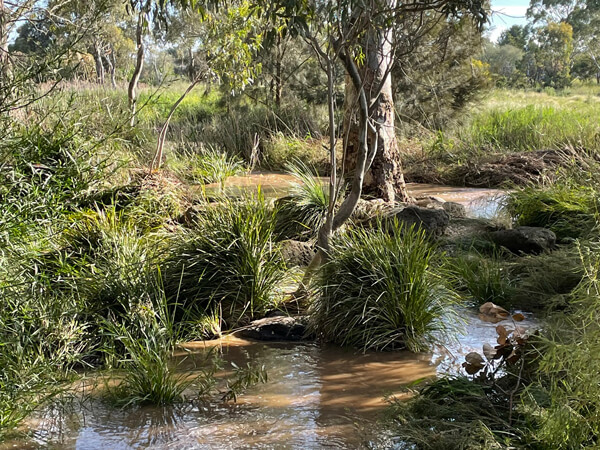
Hovells Creek begins at the base of the Three Sisters, a series of volcanic scoria cones near Anakie that formed over a million years ago. The creek flows through limestone-rich landscapes past the You Yangs and into Limeburner’s Lagoon, eventually joining Corio Bay. Its slow-moving waters are fed by rain falling in the northwest of its catchment area.
In the 1960s, Ian McLean Turner developed the subdivision, which included Wingara Drive and planted the first trees along Hovells Creek. When Kevin and Beverley Hoffman purchased their block of land in 1967, they began nurturing these young ironbark trees, initially by hauling buckets of water from the creek. By January 1970, when they moved into their completed home, the trees were only about two feet high. Despite considering a generator to pump water, they found the creek water too brackish for irrigation, adding to their challenges.
Initially, Kevin focused on creating their own garden. However, his attention soon turned to the nature strip across the road from their home and then along the banks of the Creek. By around 1975, Kevin had begun work to beautify this area, starting with basic cleanup tasks like removing rubbish and boxthorn. His vision for what would eventually become the Kevin Hoffman Walk started to take shape.
Flooding and Infrastructure
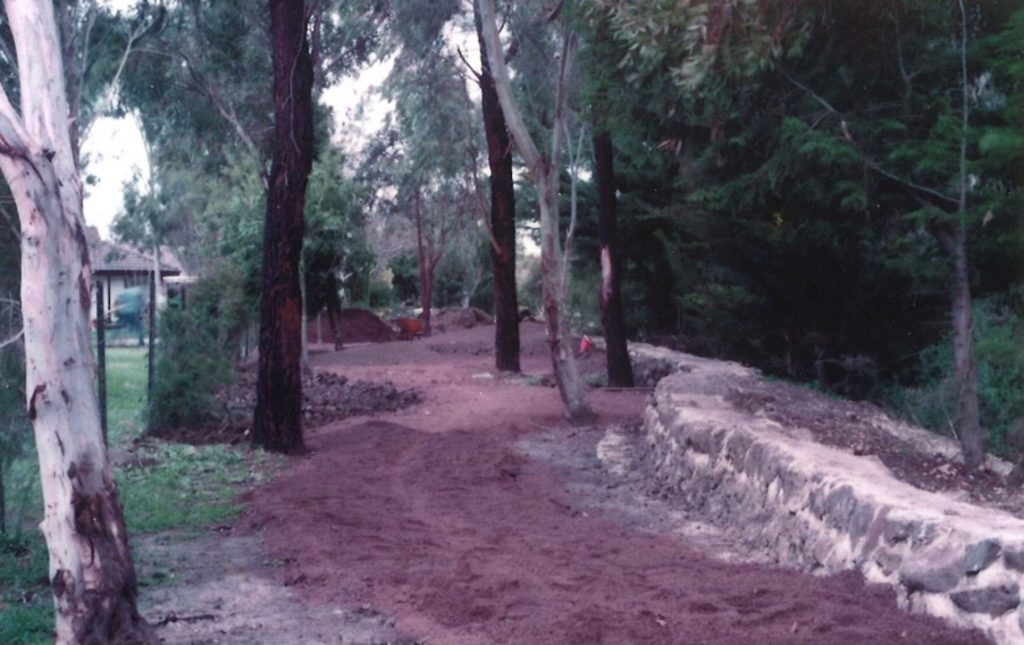
In 1973, the area experienced a severe flood, with 190 millimeters of rain falling in just 20 hours. The flooding damaged the banks of Hovells Creek and impacted 15 homes along Flinders Avenue and Wingara Drive. To mitigate future flooding, a stone levee wall was constructed in 1974 under the Government Regional Employment Development Scheme (REDS).
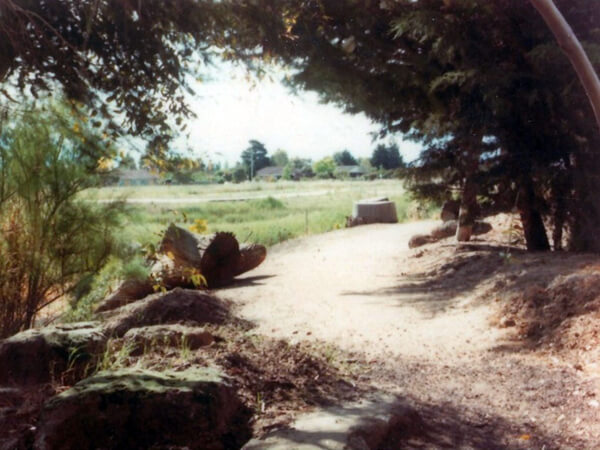
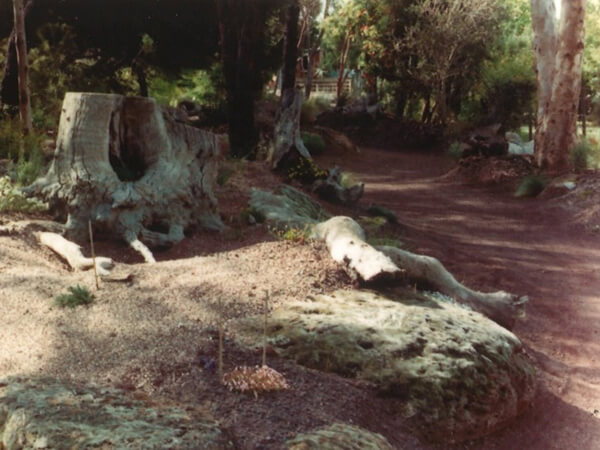
In 1976, the Shire of Corio sealed Wingara Drive and installed a water main, facilitating further planting along the creek. Kevin’s efforts expanded, and over the years, he brought in soil, rocks, tree stumps, pots, and plants to enhance the area. He also built features such as steps, seats, and an earth sculpture near the Walkers Road end.
Community Recognition
By 1982, Kevin’s efforts had transformed the area into a standout feature of the community. That year, Wingara Drive received an Outstanding Streetscape Award, presented by then Victorian Premier John Cain. Around the same time, David Martin, a young Wingara Drive resident and landscape architecture student, won an international design award for his “Landscape Masterplan,” which encompassed the Kevin Hoffman Walk as well as the open space and wetlands opposite known as The Duck Ponds.
The Shire of Corio adopted David’s masterplan in 1983 as part of a flood prevention program. Early revegetation efforts along the creek corridor in 1984 and 1985 used locally grown River Red Gums and other indigenous plants, creating a cohesive environment integrated with the Walk.
Challenges and Flood Mitigation
In 1984, sewer connections in Lara disrupted parts of the Walk, but these sections were eventually repaired and replanted. In the late 1980s, in approximately 1987, the Shire of Corio undertook significant flood mitigation works, constructing levee banks along Forest Road, Flinders Avenue, Wingara Drive, and Melrose Street.
The largest flood on record occurred in 1988, with 120 millimeters of rain falling in just five hours on already saturated ground. The levee bank at Ponds Drive breached, flooding 78 properties, with 60 experiencing internal damage. The flood caused widespread disruption, including inundation of Station Lake Road Bridge and other key routes. The levee bank was repaired and raised by 60 centimetres in some areas to prevent future breaches.
The Kevin Hoffman Walk is Officially Named
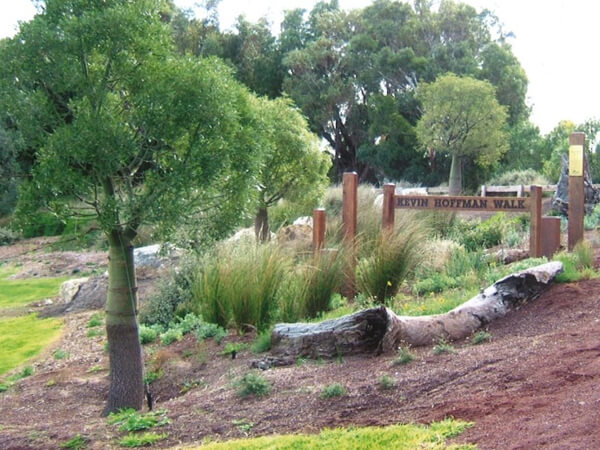
In 1991, the Shire of Corio recognised Kevin’s dedication by officially naming the area between Wingara Drive and Walkers Road the Kevin Hoffman Walk. Over the years, Kevin extended the Walk to connect Station Lake Road and Flinders Avenue, creating a continuous corridor for the community to enjoy.

Modern Enhancements and Cultural Recognition
In 2013, the Friends of Kevin Hoffman Walk Inc. was formed to help Kevin maintain and preserve this significant native parkland. Two years later, in 2015, the Walk celebrated its 40th anniversary and in the same year, the creation of an indigenous garden between Walkers Road and Flinders Avenue, completed the link between Station Lake Road and Flinders Avenue.
In 2017, the Walk acknowledged the Wathaurong people, the traditional custodians of the land, by installing seven Wathaurong glass-inlaid bollards near the Walkers Road entrance. These bollards depict traditional spirits and entities, including Bunjil the Wedge-Tail Eagle, Lelon the Lizard, and Gerrang the Gum Leaf, which symbolises safe passage through Wathaurong land. For more information about the bollards, [click here].
A Lasting Legacy
Kevin Hoffman’s vision and dedication transformed a simple creek corridor into a vibrant, native garden that continues to be a source of beauty, relaxation, and community pride. Thanks to ongoing efforts from the Friends of Kevin Hoffman Walk and the support of the local community, the Walk remains a living tribute to Kevin’s passion for the natural environment.